
Brainspotting Therapy vs EMDR: Which Is Best for You?
If you’ve been feeling stuck, overwhelmed, or like your trauma is taking up way too much space in your life, you’re not alone. Many women across North Carolina, from Charlotte, Asheville, Chapel Hill, Cary, or Davidson, are searching for real healing, not just coping. Two of the most effective trauma-focused therapies offered virtually today are Brainspotting and EMDR (Eye Movement Desensitization and Reprocessing). But how do you know which one is right for you?
As a therapist who works virtually with women in high-stress, high-performing roles (especially moms balancing way too much), I often get asked this question. Let’s break down both therapies, explore the differences, and help you figure out which one might best support your healing journey.

What Is EMDR?
EMDR is a structured therapy developed in the late 1980s that uses bilateral stimulation (usually eye movements, tapping, or sounds) to help your brain reprocess traumatic memories. The idea is that your brain gets “stuck” in trauma loops, and EMDR helps move the memory from emotional overwhelm to resolution.
You focus on a distressing memory while following a set of eye movements guided by your therapist. This activates both hemispheres of the brain, helping you reprocess the memory so it no longer feels activating or overwhelming.
Commonly treated with EMDR:
- PTSD and trauma
- Anxiety
- Phobias
- Grief
- Childhood abuse or neglect
What Is Brainspotting?
Brainspotting (BSP) is a newer therapeutic approach developed in the early 2000s. It was actually discovered during an EMDR session. The premise is that where you look affects how you feel, literally. A Brainspotting therapist helps you find an eye position that activates a stuck memory, emotion, or physical response, and you stay with that spot to allow deeper processing.
It’s less structured than EMDR and doesn’t require talking about the traumatic memory in detail. It also works beautifully in virtual therapy, which is ideal for busy women balancing work, family, and healing from the comfort of home.
Commonly treated with Brainspotting:
- Complex trauma– PTSD, Childhood abuse or neglect
- ADHD-related overwhelm
- Anxiety and burnout
- Chronic pain
- Grief
- Phobias
- Emotional dysregulation

Key Differences Between EMDR and Brainspotting
1. Structure vs. Flow
EMDR follows eight clearly defined phases, moving from history taking through memory activation, bilateral stimulation, and closure in a fairly predictable sequence. This structure can feel reassuring if you like knowing what to expect from session to session.
Brainspotting works differently. Rather than moving through fixed phases, your therapist helps you locate an eye position connected to what you are feeling in your body, then simply stays with you there. There is no set number of steps to move through, which means each session can look different depending on what comes up.
2. Talking vs. Felt Sense
In EMDR, verbal processing is part of how the therapy works. You talk through the memory while your therapist guides bilateral stimulation, and that narration is considered part of the reprocessing.
Brainspotting asks much less of you verbally. You may describe a sensation once, a tightness, a heaviness, a pull, and then simply notice what happens as you stay with that eye position.
For clients who freeze up or feel overwhelmed when asked to narrate painful memories in detail, this difference alone can make Brainspotting feel more accessible.
3. Conscious vs. Subcortical Processing
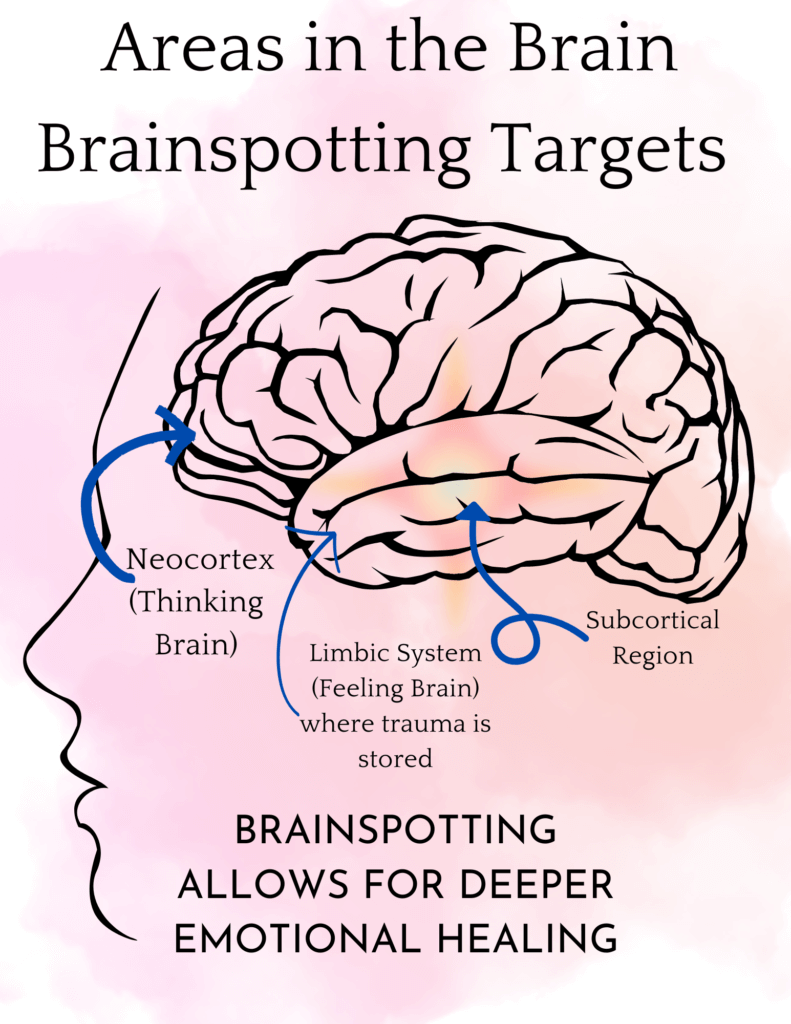
Both therapies aim to reach beyond the thinking, narrating part of the brain, but Brainspotting is believed to access the midbrain more directly, the older, survival based region where trauma responses are stored outside of conscious language. This is part of why Brainspotting sessions can produce physical release, tears, warmth, tingling, a sense of weight lifting, even when very little has been said out loud.
4. Ideal for Virtual Therapy
EMDR can be adapted for telehealth, but some of its bilateral stimulation techniques were originally designed for in person delivery and can require more adjustment online.
Brainspotting was built around something telehealth already does well: sustained visual focus. All it requires is your therapist guiding your eyes to a position on screen and your willingness to stay present with whatever arises, which makes it one of the more naturally virtual friendly trauma therapies available today.
How Brainspotting Compares to Other Trauma Therapies
EMDR and Brainspotting are the two most well known body based trauma therapies, but they are not the only ones. You may also come across Accelerated Resolution Therapy (ART) and Deep Brain Reorienting (DBR) while researching your options.
ART is a shorter term, more structured approach that also uses eye movements, but it typically follows a scripted protocol over a small number of sessions, often just one to five. It tends to work quickly on specific memories but offers less of the open ended, felt sense processing that Brainspotting is known for.
Deep Brain Reorienting is a newer approach that focuses specifically on the earliest physiological moment of a shocking or overwhelming event, sometimes described as the split second before an emotional reaction even begins. It shares some theoretical ground with Brainspotting in that both work with pre-verbal, body based processing, but DBR narrows in on that initial orienting response rather than following the more flexible spot to spot process used in Brainspotting.
If you have looked into EMDR, ART, or DBR and none of them felt like quite the right fit, Brainspotting’s flexibility is often what sets it apart. There is no fixed script to follow, which means sessions can adapt to exactly what your nervous system needs that day.
Which Therapy Is Better for You?
Here are a few scenarios that might help you decide:
Choose EMDR if:
- You want a highly structured approach
- You’re ready to revisit specific traumatic memories
- You like guided steps and measurable progress
- You feel comfortable talking about your past
Choose Brainspotting if:
- You don’t want to talk through your trauma
- You’re dealing with chronic anxiety, overwhelm, or emotional shutdown
- You want to heal deeper, non-verbal trauma
- You have ADHD and want a more body-based experience
- You prefer a calming, intuitive session structure
- You’ve tried EMDR and had little success or haven’t had lasting success.
Why Brainspotting May Be the Better Choice for Deeper, Personalized Healing

While both EMDR and Brainspotting are powerful tools for trauma healing, many clients find Brainspotting to be a more intuitive and personalized experience. Because it gently accesses the midbrain. This is where trauma is deeply stored. Brainspotting allows for deeper processing without the need to retell painful stories or follow structured protocols. This flexibility often feels safer, especially for overwhelmed moms juggling mental load, past trauma, and emotional fatigue. If you’re seeking a healing method that meets you exactly where you are (emotionally and neurologically), Brainspotting may be the more compassionate and effective choice.
Brainspotting Done Virtually

Whether you’re in Charlotte, Chapel Hill, Asheville, Cary, Davidson, Matthews, Wilmington, Weddington, or Waxhaw, therapy is accessible. You don’t have to sit in traffic, take hours off work, or feel nervous in a waiting room. You can access powerfully healing trauma therapy in your own home, where you can feel most comfortable.
Brainspotting, in particular, is incredibly effective over telehealth. All you need is a quiet space, a stable internet connection, and your willingness to go inward.
Real Talk: What Clients Say About Brainspotting
Women often say Brainspotting feels like the first time therapy actually “worked.” They don’t have to explain everything. They feel the shifts in their body. Some cry, some feel heat or tingling, others notice a weight lifted.
Many moms I work with describe Brainspotting as a reset button for their nervous system. After years of anxiety, burnout, and feeling like they’re failing at everything, they start to feel more regulated, more themselves.
And you deserve that, too.
Ready to Try Brainspotting?
The good news? You don’t have to choose right now. Let’s talk about what you’re dealing with, what your goals are, and we can figure out the best approach together.
I offer virtual brainspotting therapy for women across North Carolina and South Carolina. Whether you’re juggling work and motherhood in Charlotte, stuck in survival mode in Cary, or longing for calm in Chapel Hill, you’re not alone.

Healing Is Possible with Brainspotting
Both Brainspotting and EMDR are powerful trauma therapies. There is no one-size-fits-all answer, but with the right therapist and approach, healing is absolutely possible.
Let’s take that first step together.
Book a free consultation to learn which approach may be right for you.
Frequently Asked Questions
Is Brainspotting the same as EMDR?
No. Brainspotting and EMDR are related but distinct therapies. Brainspotting was actually discovered during an EMDR session, but it has since developed into its own approach that is less structured, relies on sustained eye position rather than repeated eye movements, and typically requires less verbal detail about the traumatic memory itself.
What is the main difference between EMDR and Brainspotting?
EMDR follows eight structured phases and uses repeated bilateral stimulation while you talk through a specific memory. Brainspotting is more open-ended, using a single sustained eye position while you tune into physical sensation, often with little to no talking required.
Can Brainspotting be done virtually?
Yes. Brainspotting works well over telehealth. Unlike some other trauma therapies, it does not require specialized equipment, only a quiet space, a stable internet connection, and your therapist guiding you to a relevant eye position on screen.
Is Brainspotting better than EMDR?
Neither therapy is universally better. Brainspotting tends to be a better fit for people who do not want to talk in detail about their trauma, who feel emotionally shut down, or who have tried EMDR without lasting relief. EMDR tends to suit people who prefer a structured, step by step process. The right choice depends on your history, your nervous system, and what feels safe to you.
Where can I find a Brainspotting therapist in Charlotte, NC or Matthews, NC?
Eleena Hardzinski, LMFT and Certified Brainspotting Therapist, offers virtual Brainspotting therapy to women throughout Charlotte, Matthews, and the greater North Carolina and South Carolina area. She’s also able to see clients in Tennessee, Illinois, and Wisconsin. Sessions are conducted entirely online, so you can access care from home no matter where you are in the state.

Eleena Hardzinski is a Licensed Marriage and Family Therapist and a Certified Brainspotting Therapist who practices online in North Carolina, South Carolina, Tennessee, Illinois, and Wisconsin.
Eleena supports women struggling with motherhood, relationships, past traumas, ADHD, anxiety, and more. She helps overwhelmed moms find balance, overcome guilt, establish healthy boundaries, heal from past traumas, improve family communication, and regain confidence and joy in their lives.